NVIDIA CEO Risk: Will a Leadership Change Trigger a Crash? Best Stocks to Buy Now
Explore NVIDIA CEO risk analysis, historical market resilience during tech leadership crises, and top alternative tech stocks to buy.
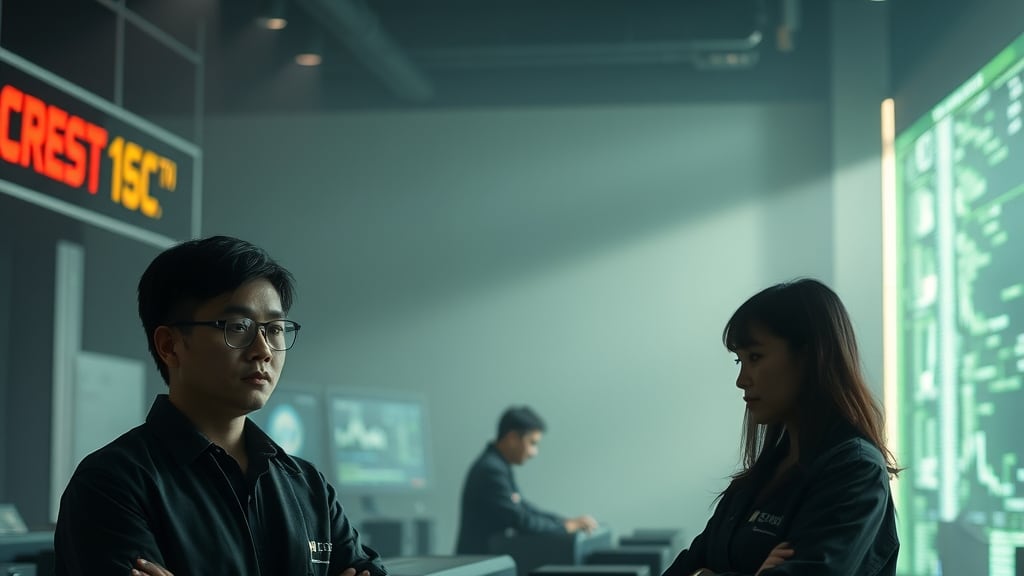
Does a myth inevitably perish with the downfall of its creator, or does it acquire a life of its own and endure forever? When a chief executive's personal crisis shakes a massive empire in the global capital market, we are forced to confront a harsh reality.
Key Insights
1. The Light and Shadow of Charismatic Leadership and Structural Risks
Nietzsche proclaimed that the birth and fall of a hero always take place upon the collective illusions of the masses. Today, the power sustaining NVIDIA has likewise depended excessively on the charisma of a single, peerless figure, Jensen Huang. Much like legendary founders of the early 20th century like steel tycoon Carnegie, or modern visionaries like Elon Musk and Mark Zuckerberg, these leaders become synonymous with the corporate identity itself. However, this structure harbors a massive Achilles' heel. When personal scandals surrounding a CEO emerge—especially those related to national security or confidential matters—the market instantly plunges into panic. Historically, stock prices of such companies tend to plummet by 10% to 20% in the short term immediately following a sudden departure or scandal involving the CEO. As Boeing and numerous tech companies of the past have proven, organizations built on a 'one-man show' inevitably experience extreme turbulence in the leader's absence. In particular, a centralized structure where over 70 key executives report directly to a single CEO achieves peak efficiency, but simultaneously harbors a fatal vulnerability: if that single point fails, the entire system paralyzes.
"When a chief executive's personal crisis shakes a massive empire in the global capital market, we are forced to confront a harsh reality."
2. Historical Precedents and Market Resilience
When a storm rages, the entire forest shakes, but a giant tree with deep roots inevitably stands back up from the earth. A careful analysis of numerous capital market scandals and leadership crisis cases from the past reveals that the steep drop right after an event is frequently an emotional overreaction. Statistically, turbulence and volatility persist for 30 days following a leader's departure or negative news, but as 90 days pass, stock prices gradually recover based on the company's intrinsic value and fundamentals. This ecosystem, commanding an overwhelming market share of over 80% in the GPU market, is not fragile enough to be completely dismantled simply by one individual's reputation or tenure. Solid supply chains with TSMC, the Taiwan-based semiconductor foundry giant, and the hardware monopoly that has become essential for running global artificial intelligence models form a physical barrier that no political scandal can instantly tear down. A leader is merely a compass providing the company's vision; what actually turns the wheels is the already sophisticated system and vast infrastructure. Therefore, while short-term shocks may be an unavoidable rite of passage, they cannot alter the long-term direction of the paradigm.
- Short-term shock typically lasts for about 30 days of market turbulence.
- Fundamentals and intrinsic value drive recovery by the 90-day mark.
- Strong manufacturing partnerships and hardware monopolies provide an unbreakable moat.
3. The Age of Uncertainty: New Alternatives for Tech Investing
The adage not to put all your eggs in one basket shines as a true golden rule in the high-tech industry where volatility reaches extremes. Just as a single stock scandal cannot halt the growth of the entire artificial intelligence industry, investors must diversify their portfolios from a macroscopic perspective. In a phase where concerns over slowing data center computing speeds overlap with specific corporate risks, it is only proper to turn one's eyes toward sectors equipped with both defensive characteristics and long-term growth drivers. Alongside hyperscalers, cybersecurity stocks act as structural safety nets whose demand increases proportionally as the AI ecosystem expands. Furthermore, massive upcoming events like Anthropic's initial public offering (IPO) can serve as catalysts injecting fresh vitality into dampened investment sentiment. Ultimately, now is not the time to abandon the massive civilizational transition of artificial intelligence, but rather an inflection point to intricately distribute risks and preempt the opportunities of the next stage. Are we truly being dazzled by the shadow of a hero, missing the genuine future value quietly expanding behind it?
This post is based on content from the YouTube channel 올랜도 더 미국주식.
Watch the original video: https://youtu.be/rRC0H8Px5M8
Note: This content is a column written with AI analysis based on the referenced video. For accurate context and the creators intent, we recommend watching the video via the link above.

