Navigating the AI Investment Volatility Amid Rising Rates and a Strong Dollar
Explore how surging interest rates and a strong dollar are shaking AI investments, and discover strategic insights for navigating market volatility.
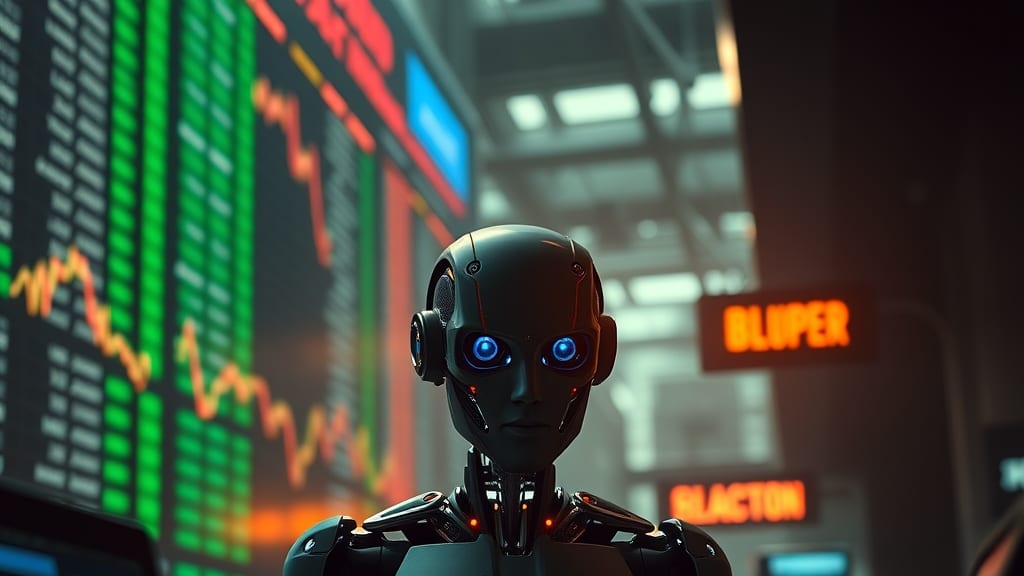
What a captain without a compass faces in a stormy sea is not fear, but the discovery of a new route. The turbulence currently experienced by the capital markets is not merely a precursor to a recession, but a massive historical inflection point that re-examines the very essence of capital.
Core Insights
1. The Massive Macroeconomic Waves and the Shadow of Macro Variables
The modern capital market, which tests the limits of human cognition, always fluctuates due to the collision of unexpected variables. The combined pressure of a surging strong dollar and rising interest rates recently shaking global financial markets acts like a giant tsunami, reshaping the very flow of capital beyond individual corporate earnings or technological superiority. Just as truth evolves through contradiction in Hegel's philosophy of history, the market finally finds its natural equilibrium point only after passing through moments when overheated expectations collide with the cold reality of macro indicators. The steep rise in 2-year and 10-year Treasury yields signifies a contraction in liquidity, proving that the cost companies must pay to raise funds and plan for the future is skyrocketing. Historically, macroeconomic tectonic shifts have always pointed their blades first at economic agents overly reliant on leverage. The shaking of artificial intelligence-related assets we are witnessing now is not a technological failure, but a painful process of re-validating capital efficiency within the cold reality of a high-interest-rate environment. As John Maynard Keynes pointed out, when the market pivots rapidly from reckless optimism to deep pessimism, investors easily fall prey to collective panic. However, true insight begins with separating assets with genuine value from temporary liquidity bubbles amidst this macroeconomic noise. The rise in interest rates does not simply act as a factor depressing stock prices; it serves as a mirror revealing companies' capital allocation capabilities and cash-generating power in stark relief. Therefore, to survive this storm, rather than being swayed day-to-day by short-term price fluctuations, we must multi-dimensionally dissect how the direction of monetary policy and exchange rate volatility impact the real economy and corporate financial structures.
"The shaking of AI-related assets is not a technological failure, but a painful process of re-validating capital efficiency in a high-rate environment."
2. The Light and Shadow of Tech Stocks and the Cold Judgment of Capital Efficiency
Cutting-edge tech companies standing at the forefront of innovation have always grown amidst a duet of praise and criticism. Despite explosive recent sales growth, the financial statements of companies pioneering the future with massive capital expenditures are encountering heavy reefs of surging debt and interest expenses. Just as paradigm shifts in Thomas Kuhn's structure of scientific revolutions accompany cracks in the existing system, the AI industry has also faced the test of generating actual cash flow against astronomical investment funds. The stock price volatility demonstrated by key players in the semiconductor ecosystem, including Nvidia, shows a cold attitude shift where market participants no longer open their wallets based solely on rose-colored blueprints. The phenomenon where capital costs and interest repayment burdens soar alongside rapidly increasing sales raises a fundamental question: do companies possess the physical stamina to handle their own growth speed? The reason why high-flying stocks coveted by some market analysts suddenly face a flood of profit-taking sell-offs is that future value can crumble helplessly before the harsh discount rate of current high interest rates. In phases where technological superiority does not immediately translate into financial performance, management's capital allocation strategy and financial soundness act as decisive variables separating corporate life and death. Amidst this massive civilizational transition called artificial intelligence, the market ultimately applies the law of the survival of the fittest without mercy, separating companies that are mere illusions from those building substantial moats. Investors now face an era where they must inspect companies' free cash flow and debt repayment capabilities with a magnifying glass, stepping away from flashy slogans or the magic of the word innovation.
Key challenges currently facing high-growth tech companies include:
- Explosive capital expenditures alongside heavy debt burdens
- The pressure to prove actual cash flow generation against massive investments
- Vulnerability of future valuations to harsh high-interest discount rates
3. The Undervalued Charm of the Domestic Market and the Shield of Dividends
Amidst the turbulence of a global market reaching peak volatility, the trajectory shown by the Korean capital market offers unique implications. Despite foreign capital outflows and a technical bear market phase where the index fell below the 200-day moving average, defensive demand seeking a new equilibrium point is stirring paradoxically within the market. As Daniel Kahneman's behavioral economics theory explains, humans possess a loss-aversion tendency, feeling the pain of losses far more sensitively than the joy of gains. The fact that the expected dividend yield has surpassed the mid-3% range—near historical highs—while stock prices fail to escape a downward trend is a strong signal implying the market has already secured a significant level of safety margin. Rather than agonizing over individual stock fluctuations, seeking sturdy resting places capable of absorbing volatility, such as solid index products or preferred stocks of large blue-chip companies, is a wise strategy. In fact, the market has recently shown a dullness toward bad news, proving a solid downside rigidity where stock prices refuse to be pushed below certain price levels. This implies that market participants have begun adopting a contemplative attitude, watching for opportunities to purchase undervalued assets rather than becoming prisoners of pessimism. Just as a small boat must lower its center of gravity to avoid capsizing in rough waves, a stock portfolio must also drop the anchor of fundamentals—definite cash flow via dividends and low PER/PBR ratios. The defensive power demonstrated by core semiconductor supply chain ecosystems, including Samsung Electronics, along with preferred stocks, eloquently speaks to what the most realistic and powerful weapon for breaking through the age of uncertainty is. The capital market always prepares its most attractive fruits in the valley of despair, and those who harvest them are solely those who do not yield to fear and quietly hold their ground behind the shield of dividends.
4. The Ultimate Wisdom of Investors Crossing the Labyrinth of Uncertainty
Every investment journey is ultimately a battle against oneself and a process of intellectual exploration finding the right direction within the labyrinth of uncertainty. At the current juncture where the fear of rate hikes, geopolitical risks, and the pros and cons of the AI craze intersect, what we must truly guard against is not external bad news, but inner impatience. As Stoic philosophy teaches, being swayed day-to-day by macroeconomic trends or the Federal Reserve's monetary policy—things beyond our control—is as meaningless as blaming one's parents' personalities. The only areas an investor can entirely control are their portfolio structure, the timing of fund execution, and the psychological stamina to endure risk. No matter how much the market shakes, there is no such thing as a permanently declining trend, and the deeper winter becomes, the more fiercely the energy of spring prepares the earth. Just as humanity's challenge toward the cosmos continues endlessly, the grand wave of technological innovation will evolve into more mature forms through temporary adjustment periods. What matters is grabbing the boarding pass for that massive evolution and surviving until the end, which requires building a robust financial buffer zone capable of absorbing shocks. It is time to focus on building structural safety nets where capital can circulate virtuously, rather than letting your gaze be stolen by the flashy fluctuations of individual stocks. Amidst the noise of macro variables right before your eyes, are you steadfastly protecting the citadel of capital based on your own principles and philosophy without shaking?
"The only areas an investor can entirely control are their portfolio structure, execution timing, and psychological stamina."
This post is based on content from the YouTube channel 이효석아카데미.
Watch the original video: https://youtu.be/DgpgHDdInkg
Note: This content is a column written with AI analysis based on the referenced video. For accurate context and the creators intent, we recommend watching the video via the link above.

