Is NVIDIA Still a Buy? Analyzing the Next Growth Phase Amid Uncertainty
Explore NVIDIA's growth potential amid leadership changes, technical indicator traps, and macroeconomic pressures. Read our in-depth US stock analysis.
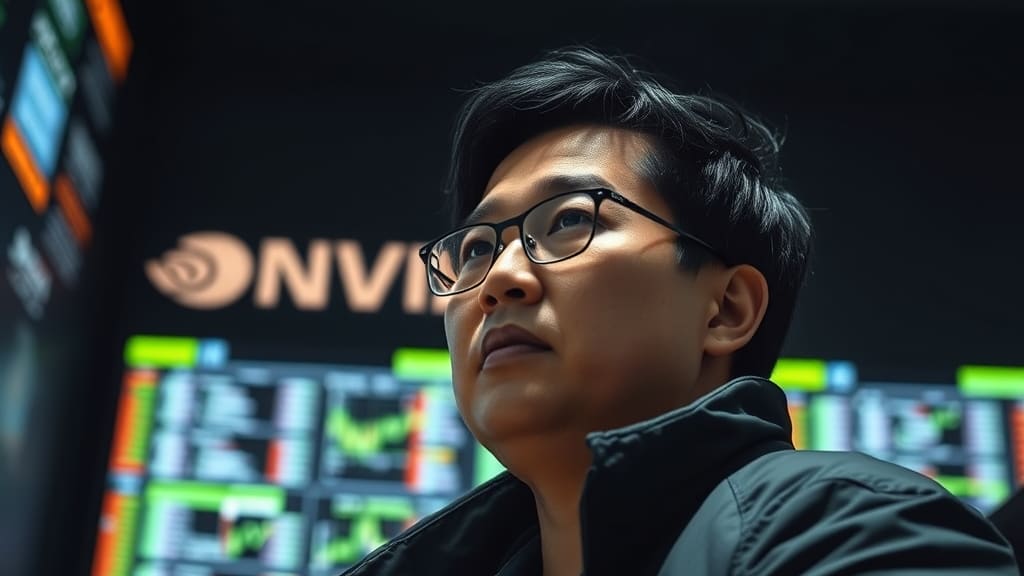
Great empires never fall from external invasions, but always from the loss of internal centripetal force and the emptiness of the throne. The sudden departure of a chief executive goes beyond a simple personnel replacement; it is a massive civilization-shaping catastrophe that tests the survival of an entire corporate civilization.
Core Analysis
1. The Absence of the CEO and the Paradox of Charisma
Innovators who change the paradigm of an era in history reign not merely as managers, but as mythical figures. The extreme turmoil the market experienced when Steve Jobs left Apple proved that a company's value is deeply rooted in an individual's intuition and vision, rather than just the sum of financial statements or production facilities. The resignation of Jensen Huang, the head of NVIDIA, follows the exact same trajectory. While the market is currently intoxicated by superficial earnings surprises and the massive demand for AI infrastructure, underlying this is the fear that the unique focal point supporting this massive ecosystem has vanished. "Key person risk" in organizational psychology does not simply mean a vacancy in headcount. It represents the existential wandering that a giant ship will face as it loses its rudder amid micro-cracks in the supply chain, psychological agitation among employees, and invisible power struggles with competitors. Until a new successor replaces the predecessor's overwhelming charisma and restores market trust, quarters of endurance are required, and the uncertainty generated during this period acts as a major factor ruthlessly shaving down the company's valuation multiple. The phenomenon where the stock price plummeted over thirty percent from its peak is not merely entering an oversold zone, but the numerical manifestation of investors' cold doubts about the empire's legitimacy and future. Even with excellent engineering capabilities and a solid ecosystem, a voyage without a compass to point the way is ultimately no different from a shipwreck wandering through a fierce storm. Therefore, the current downward trend goes beyond a temporary adjustment and is merely the prelude to a massive test that the new leadership system must prove.
Even with excellent engineering capabilities and a solid ecosystem, a voyage without a compass to point the way is ultimately no different from a shipwreck wandering through a fierce storm.
2. The Illusion of Technical Indicators and the Trap of Overselling
To overcome anxiety, humans continuously create numbers and draw charts, building the illusion that order exists within them. When the Relative Strength Index (RSI), a momentum indicator commonly used in the stock market, drops below thirty, the public instinctively tries to interpret it as a salvation signal announcing the bottom. According to historical statistics, entering an oversold state provides an opportunity for selling pressure to catch its breath or stall momentarily, but it is by no means a guarantee of an upward reversal. As the charts of 2019 and 2022 proved, while indicators crawl along the bottom, stock prices brutally demonstrated that another basement exists below, producing dozens of percent in additional declines. Overselling is merely a physical figure indicating that current selling pressure was excessive; it is not a macroeconomic indicator implying that corporate fundamentals have recovered or market trust has been restored. Rather, the phenomenon of indicators lingering horizontally at the bottom for a long time is closer to a sign that deep indifference and resignation dominate among market participants. The bottom of a stock price is not calculated by the intersection of trend lines or the reaching of a specific figure, but is finally formed the moment widespread uncertainty in the market is resolved and new valuation criteria are established. The act of predicting the bottom solely relying on the melody of charts is no different from an adventure of jumping into the sea in pitch darkness without a lighthouse. A true bottom comes with the proof of practical performance from the new leader who will guide the company, not numbers on a chart.
3. The Invisible Hand of Macroeconomics and the Rampage of Interest Rates
Microeconomic corporate valuation always takes place within the massive gravitational field of macroeconomics. No matter how dazzling an individual company's innovation and monopolistic status may be, it becomes helpless in front of the massive tsunami of central bank monetary policy and geopolitical risks that determine global capital flows. The steep rise in short-term Treasury yields recently observed in the bond market warns that the Federal Reserve's hawkish stance is still choking the market. As the aftermath of monetary tightening to curb inflation prolongs, the risk-free rate rises day by day, forcing investors who bet on high-risk growth stocks to face a harsh reality. In an environment where the appeal of safe assets surges, the multiples of tech stocks carrying future uncertainty inevitably shrink. On top of this, instability in international politics and geopolitical conflicts surrounding resource supply chains cause oil prices to spike, rekindling the embers of inflation. The combined action of these macroeconomic bad news acts as an Achilles' heel that maximizes stock market volatility, testing investors' risk-tolerance to the limit. When the internal risk of individual corporate CEO replacement and external shocks such as global rate hikes and rising oil prices collide head-on, the market undergoes a structural realignment process beyond simple adjustment. Capital is not swayed by emotions and moves only on the balance scale of return and risk. The attitude of blindly believing in the undervaluation appeal of a specific company while ignoring macroeconomic trends is no different from standing alone with an umbrella closed in an approaching economic typhoon.
4. The Age of Uncertainty: Fundamental Questions Investors Must Ask
Every moment of crash and crisis always demands cold reflection from market participants. Are we truly investing in the substance of the company, or were we addicted to the glamorous illusions created by the market and the dopamine of rising stock prices? The current vortex surrounding NVIDIA is not just a stock price drop hap, but a mirror showing the most primitive vulnerabilities a giant corporation can face amid a rapidly changing tech paradigm. Amid the triple hardship of missing leadership, technical indicator illusions, and macroeconomic pressure, the best attitude an investor can take is not blind dip-buying, but critical detachment to verify the durability of the entire system. During the time until new management is appointed and they prove their capabilities through earnings, the market will continuously test investors' patience and conviction. Risk-tolerance capable of handling volatility does not simply mean the courage to endure losses, but the wisdom to face the fundamental structural contradictions in how capital markets operate and adhere to one's own investment philosophy within them. When the guardian of the ship disappears in the storm, passengers either panic and jump into the sea or roam the cabin looking for a new captain. Is the stock in your hand a sturdy ship that can withstand the new storm and reach its destination, or is it merely a shabby raft that will easily break in rough currents?
- Evaluate corporate leadership changes and key person risks carefully.
- Do not rely solely on technical indicators like RSI to find market bottoms.
- Keep a close eye on macroeconomic factors such as Fed interest rates and bond market yields.
This post is based on content from the YouTube channel 올랜도 더 미국주식.
Watch the original video: https://youtu.be/-vZgkAzZE1A
Note: This content is a column written with AI analysis based on the referenced video. For accurate context and the creators intent, we recommend watching the video via the link above.

