Will Interest Rate Hikes Never End? Analyzing the Fed's Tightening Cycle
Explore whether ongoing interest rate hikes are a single event or a continuous trend. Understand the Fed's policy dilemma, market impacts, and economic outlook.
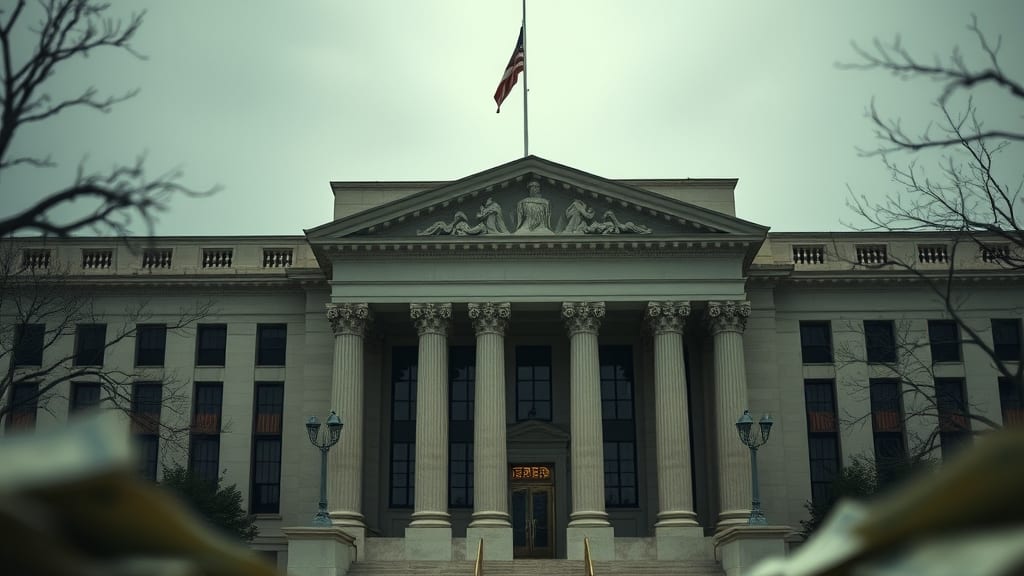
Just as a natural storm doesn't end with a brief shower but leads to a drought that parches the earth, short-term prescriptions from monetary authorities are also recorded as the prelude to a long-term trend that alters a massive economic ecosystem. What coordinates must we establish amidst the sandstorm of uncertainty where we cannot see even an inch ahead?
Core Content
1. The Dilemma of Defensive Policies and the Loss of Proactive Response
Historically, when central banks coordinate the landscape of macroeconomics, delayed defensive interventions have always left severe scars on the market. The image of a firefighter stepping in to extinguish flames only after the wildfire has already swallowed the grassland starkly proves the inherent time lag and helplessness of monetary policy. The Time Lag Trap in economics is maximized precisely at such moments. The act of central authorities pressing the interest rate hike button is not merely a technical adjustment, but rather a desperate struggle to retrospectively fix past policy miscalculations. If the central bank had captured early signs of inflation and proactively pulled out the rate hike card, the ruthless tightening vortex we see today could have been avoided. However, successive big steps and giant steps executed when the levee has already burst instill extreme fear in market participants. In this phase, the capital market escapes the realm of rational forecasting and falls into a collective panic state, facing a destiny where the value of risk assets collapses steeply. Even inside the central bank, officials know well that a single minor rate hike falls short of suppressing soaring inflation. Ultimately, one hike acts as a catalyst for another, and the market walks into an endless tightening tunnel.
2. Monetary Policy Inertia and the Disappearance of Forward Guidance
It is tragic that Newton's law of inertia is not confined to physics but applies just as smoothly to human-designed economic systems. Once the massive rudder of monetary policy turns toward tightening, enormous social costs and time are consumed before steering it back toward easing. The days when the Federal Reserve was confident it could induce a soft landing through fine-tuning have already passed into history. When decision-makers themselves admit the limitations of fine-tuning and refuse to provide clear guidelines to the market, the market naturally overreacts by imagining worst-case scenarios. The absence of forward guidance—where monetary authorities fail to present a transparent blueprint for the future interest rate path—acts as a primary factor amplifying the volatility of speculative capital. As economist Milton Friedman warned, uncertain monetary policy does not act as medicine but returns as poison to the economy. Market participants gaze solely at the mouth of the central bank, causing extreme price fluctuations over trivial remarks, which sharply contracts investment sentiment in the real economy. Once the trigger for a rate hike is pulled, it tends not to end as a one-off event, but solidifies into a massive trend momentum that cumulatively raises rates for years to come. This policy inertia ultimately drives up corporate borrowing costs, triggering a destructive chain reaction that accelerates the bankruptcy of marginal companies and deepens household debt burdens.
3. The Massive Discord Between Supply Shocks and Tightening Prescriptions
The fact that the nature of inflation facing the modern economy stems from the structural collapse of supply chains rather than overheated demand raises fundamental questions about the utility of monetary policy. Geopolitical tensions in the Persian Gulf, the re-escalation of international oil prices, and the rupture of global supply chains are not matters that can be resolved with the blunt instrument of a central bank rate hike. This is precisely why some policymakers argue during decision-making processes that tightening responses to inflation driven by supply shocks should be restrained. Raising interest rates to curb demand is akin to inflicting double torture on a real economy suffering from supply shortages. It is like blindly administering strong fever reducers to a sick patient without knowing the root cause. Nevertheless, whenever the latest economic indicators exceed expectations and core consumer price indices show solid trends, the Fed's hawkish voice grows louder. Under the pretext of data-dependent monetary policy, it commits the folly of turning a blind eye to the structural vulnerabilities of the macroeconomy and becoming obsessed with a single inflation index number. This disconnect ultimately creates a massive gulf between monetary authorities and the real economy, functioning as a primary fuse that amplifies systemic risk across asset markets.
4. The Crossroads of Political Pressure and Compromised Independence
The independence of the central bank is like an invisible anchor sustaining a democratic market economy, but fierce political interference has always shaken that anchor. The dynamic relationship between the executive branch and monetary authorities is a chronic variable blurring the purity of interest rate decisions. Situations where White House leaders or core regime figures publicly pressure for rate cuts, and pro-government figures are appointed or expected to be appointed to key Fed positions, fundamentally shake the credibility of monetary policy. The moment political logic overwhelms economic rationality, the central bank misses the golden time to control inflation forever. When an institution meant to promote long-term price stability is swayed by short-term economic stimulus or political popularity, the price is paid entirely by the public and investors. Even though dot plots and economic projections warn of sustained interest rate hike pressures for the coming years, the gap between political rhetoric and economic reality is rarely narrowed. Amidst this structural confrontation, the market loses direction, and asset prices produce extreme rollercoaster rides. Do we truly secure a final stronghold to protect the true value of capital within this political-economic vortex?
Once the trigger for monetary tightening is pulled, it rarely stops at a single event; it evolves into a systemic momentum that reshapes the entire financial landscape.
This post is based on content from the YouTube channel 올랜도 더 미국주식.
Watch the original video: https://youtu.be/0clctt3zJAo
Note: This content is a column written with AI analysis based on the referenced video. For accurate context and the creators intent, we recommend watching the video via the link above.

