Why Falling Oil Prices Saved the Stock Market While Bond Yields Surge
Explore how falling oil prices rescued major stock indices while rising bond yields and inflation fears continue to challenge the US market.
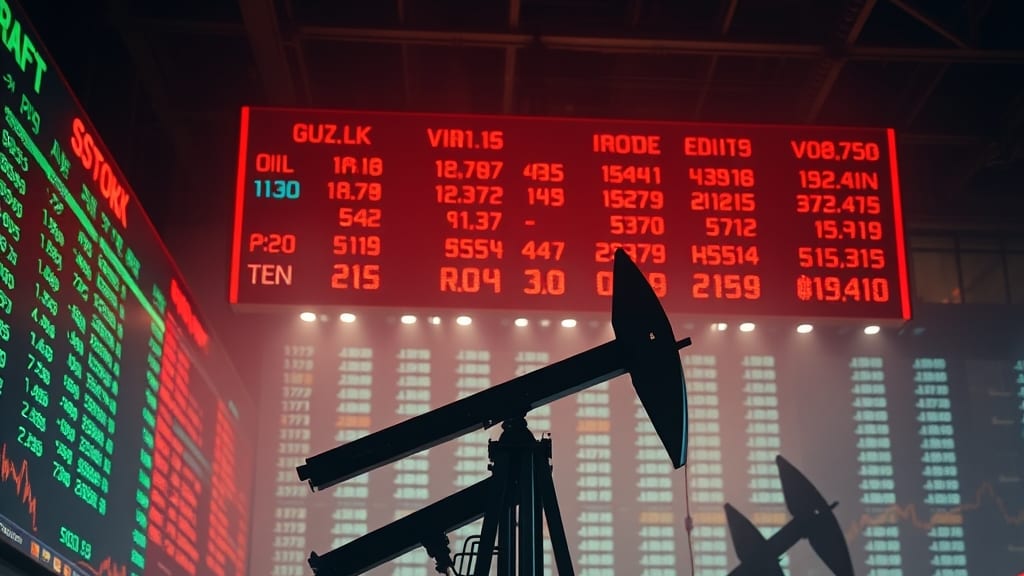
Just as Prometheus faced a tragic punishment for gifting fire to humanity, our reliance on fossil fuels as a source of energy has returned as a massive dilemma, tightening a noose around global capital markets today. Are we truly gazing at the essence of capital while cheering for a temporary pause in energy prices?
Core Analysis
1. The Dominance of Energy and the Illusion Brought by Falling Oil Prices
In economics, crude oil functions far beyond a simple commodity; it acts as the absolute lubricant for all production activities and the constant that determines cost structures. As the 1973 oil shock proved, a sudden spike in energy prices immediately triggers cost-push inflation across the entire supply chain, choking the real economy. The recent simultaneous rebound in major indices, including the S&P 500 and Nasdaq, was paradoxically made possible because the temporary retreat of oil prices—such as Brent crude and WTI—served as a crucial catalyst. Had the upward price momentum of crude oil continued unabated, no amount of strong macroeconomic data could have defended the stock market from downward pressure. This is evidence that market participants still rely excessively on energy supply and demand dynamics despite inflation fears. Much like the evils of land monopoly pointed out by Henry George, modern capitalism also bears the structural limitation of being periodically choked by the price monopoly of a specific resource called energy. When energy prices fall, corporate production costs decrease, immediately injecting warmth into the stock market by improving margins. However, because this phenomenon is closer to the alleviation of a temporary external shock rather than structural health improvements, investors carry the destined burden of constantly preparing for volatility in the oil market that can reverse at any moment.
"The recent stock market rebound was paradoxically made possible because the temporary retreat of oil prices served as a crucial catalyst."
2. The Psychological Disconnect Between Consumer Prices and Expected Inflation
Human economic behavior tends to be driven by psychological factors such as expectations and fear of the future rather than rational calculation. Although the recently released CPI and Core CPI figures matched or slightly exceeded market expectations, the stock market cheered them as positive signals. This suggests that the financial market is not necessarily expecting perfect price stability, but is rather fueled by a sense of relief that an uncontrollable worst-case scenario was avoided. Keynesian 'animal spirits' operate precisely in this kind of phase. The market responds more sensitively to signals that the Federal Reserve has not lost control than to the absolute figures of inflation indicators themselves. The reason the stock market showed a solid trend despite a minor rise in core inflation is that investors have already grown tolerant of the new normal of high inflation and high interest rates. However, this psychological stabilization does not mean a substantive recovery in the real economy. There is always a time lag between the reality shown by statistical figures and the expectations felt by investors, and the wider this gap grows, the greater the risk that the market will be exposed to sharp volatility. Ultimately, the release of inflation indicators serves a role akin to a collective ritual that calms the anxiety of market participants, going far beyond the mere confirmation of economic data.
- Consumer Price Index (CPI) releases act as psychological milestones.
- The Federal Reserve maintains perceived control over monetary policy.
- Investors have built a tolerance toward the high-inflation, high-interest-rate environment.
3. The Advent of the 5% Treasury Yield Era and the Realignment of Capital
Just as water flows to lower ground, capital inevitably moves toward places offering higher returns and lower risk. Currently, the 10-year Treasury yield standing on the verge of breaking 5% acts as an invisible shackle that strongly caps the upside of the stock market. In the past low-interest-rate era, a lack of alternatives funneled all liquidity into risk assets like stocks, but now a great migration of capital is taking place as government bonds—known as risk-free returns—emerge as attractive investments. This is precisely why growth stocks that rely heavily on large borrowings while having negative free cash flows, such as Google or Amazon, react extremely sensitively to interest rate changes. When interest rates rise, capital procurement costs increase exponentially, damaging the intrinsic value of companies. On the other hand, only prime companies that hold massive cash reserves or independently generate a return on capital exceeding 5% can withstand these high-interest waves. This implies that the capital market is being reorganized according to the ruthless logic of the survival of the fittest, and is also the fundamental reason why the small-cap-focused Russell index continues to show a relatively sluggish trend compared to mega-cap tech stocks. The 5% yield hurdle is not merely a number, but a massive turning point that completely rewrites the cost function of the entire capitalist system.
4. The Investor's Dilemma Amid Waves of Uncertainty
Historically, during every major transition period, the market has repeated a tightrope walk on the boundary between hope and despair. The upcoming FOMC meeting and the earnings announcements of semiconductor companies, including Micron Technology, are like Pandora's box, determining whether the current range-bound market will head upward or plunge into a deep correction. The correction centered around memory semiconductors and the differentiation trend centered around optical communications and CPUs show that a relentless generational shift for survival is taking place even within tech stocks. The behavior of hedge funds rapidly reconfiguring their portfolios using derivatives like flex options also represents the complex sentiment of institutional investors where anxiety and opportunity regarding upcoming volatility intersect. At this juncture where risk-averse capital and opportunistic speculative capital collide, individual investors must face the grand currents of macroeconomics rather than getting swayed by short-term index fluctuations day by day. Through the two giant mirrors of subtle oil price movements and the direction of bond yields, are we truly reading the real warnings thrown by the market?
This post is based on content from the YouTube channel 올랜도 더 미국주식.
Watch the original video: https://youtu.be/ws0j_gkTAwU
Note: This content is a column written with AI analysis based on the referenced video. For accurate context and the creators intent, we recommend watching the video via the link above.

