Rewire Your Brain for Investing: How Biology Sabotages Your Portfolio
Discover how evolutionary biology, cortisol, and FOMO hijack your brain during market swings, and learn how to protect your portfolio.
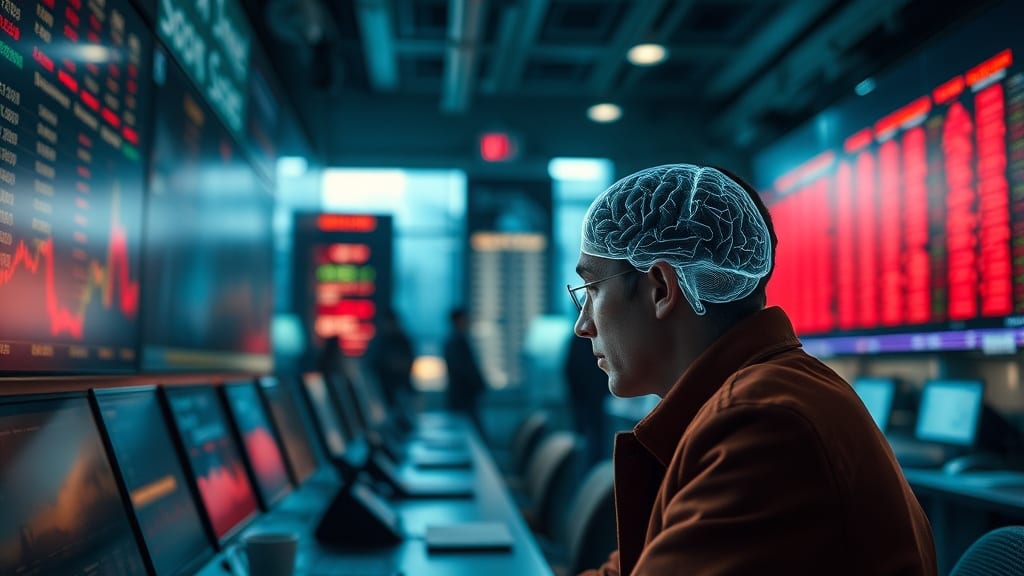
We like to believe that the stock market is a battlefield of cold mathematics and ruthless statistics, but in reality, it is merely a massive zoo dominated by the hot and flawed biological instincts of Homo sapiens who once roamed the primitive savannah. The excruciating pain we feel in our fingertips as if they were being severed when asset prices plummet is not an analytical evaluation of economic ruin, but rather a primitive scream from a brain programmed for millions of years to run away from predators.
Core Content
1. The Evolutionary Heritage: The Brain Does Not Interpret Events, It Preempts the Future
The human brain is not a high-performance camera that faces objective reality in real time, but rather a predictive organ that continuously simulates upcoming dangers based on past survival experiences. At the moment of a plunge when the market is dyed entirely blue, some feel the terror of their limbs being amputated and rush to dump their stocks, while others evoke this as a golden opportunity and secrete dopamine. This extreme cognitive dissonance is determined not by the difference in prices unfolding right before our eyes, but by the database of historical experiences accumulated by the individual in the past. The brain of someone who has the experience of breaking through past crises with courage and reaping profits mistakes a crash market for prey rather than a threat and gets excited, whereas the brain of someone with only memories of failure defines it as an emergency where fierce beasts chase them from all sides. Ultimately, victory or defeat in investment is decided not by the volatility of the external environment, but by the historical interpretation ability of the internal brain circuits that digest that volatility. The massive mirror called the market is ultimately just a projector showing what kind of memories the investor has passed through in the past. This is why we must check through metacognition what past memories our brain is holding onto and preempting a distorted future with, before objective indicators and chart analysis.
2. The Assault of Cortisol: The Principle of Stress Silencing the Commander Behind the Forehead
When asset values drop vertically, a massive earthquake of chemical substances threatening survival occurs inside the human body. Extreme stress situations release large amounts of cortisol from the adrenal cortex, and this hormone indiscriminately bombards the hippocampus, the brain's memory center, and the prefrontal cortex, which is responsible for high-level decision-making. The prefrontal cortex, located right behind the forehead, is the frontline of human intelligence that holds a long-term vision, perseveres patiently, and ponders complex problems. However, since a primitive person who sat leisurely prospecting for the future when a beast popped out of the African prairie was already eliminated from the gene pool, humanity evolved to forcibly shut down the prefrontal cortex in crisis situations and return to a amygdala-centric primitive brain that governs impulsive and immediate reactions. The terror felt while looking at a minus account on the stock screen and the act of frantically pressing the sell button are merely the dysfunctional, desperate survival struggle of a primitive man meeting a beast within the modern capitalist system. If you do not understand this biological mechanism where stress paralyzes the brain's commander and maximizes short-term escape urges, any advanced investment philosophy will inevitably collapse helplessly under the extreme pressure of a crash market.
"If you do not understand the biological mechanism where stress paralyzes the prefrontal cortex, any advanced investment philosophy will inevitably collapse under extreme market pressure."
3. Doing Nothing is the Best Policy: Decisions Made with Paralyzed Reason Lead Inevitably to Catastrophe
Due to biological inevitability, in phases of extreme volatility such as market crashes or surges, the human brain enters a state of completely losing normal judgment. All investment-related decisions made in a state where the prefrontal cortex has fallen into a state of stopped function and cortisol and adrenaline have invaded the entire nervous system are like sprinting toward a cliff in pitch-black darkness. Therefore, when the asset market faces a massive crash or extreme stress paralyzing reason and emotion strikes, the wisest and only solution an investor should take is, ironically, 'doing nothing.' A time of silence is needed to stop trading, avoid looking at the account, and be physically and psychologically isolated from all market noise. One must maintain a thorough passive defense posture until the brain detoxifies the stress toxins by itself and reboots the power of the paralyzed prefrontal cortex. Acknowledging one's own biological limitations and preparing institutional and psychological safety devices that tightly bind the hands when the brain panics and goes wild is the only defense barrier to fundamentally block the tragedy of becoming a slave to emotions and selling assets dirt cheap or falling into the trap of chasing buying.
4. The Trap of FOMO: The Terror of Alienation and the Futile Whispers of Dopamine
The human brain that ran away in terror during a downturn faces another form of primitive instinct, the FOMO (Fear of Missing Out) syndrome, in a phase where the market surges and liquidity explodes. For humanity, which evolved as a social animal, falling behind in the group meant immediate death, so the sense of alienation that I might be the only one missing the opportunity and breaking away from the ranks induces psychological pain comparable to the terror of a crash. The neurotransmitter dopamine secreted in this process is often mistaken as a substance of pleasure, but in reality, rather than pleasure itself, it is a catalyst of craving that continuously induces behavior toward greater rewards and promotes addiction. The sense of deprivation that everyone else is making a fortune in a skyrocketing market while only I am alienated overheats the dopamine circuit, completely destroying rational value evaluation and inducing fatal chase buying that purchases stocks at the peak. This tragic cycle of selling at the bottom in terror during a market downturn and buying at the peak lured by FOMO during a market uptrend is ultimately the result of the human brain being trapped in survival algorithms of short-term reward and group conformity for hundreds of thousands of years. If we do not face how our biological genes are looting modern wealth within the massive civilizational tool called the capital market, the victory or defeat of investment will always remain for those who failed to defy the instincts of the brain. Are you truly ready to control your brain under the control tower of consciousness amidst the blinding storm of hormones?
- Recognize that market panic triggers primitive evolutionary survival responses.
- Understand how cortisol and dopamine hijack your prefrontal cortex during high volatility.
- Implement strict psychological barriers and practice doing nothing during extreme market shifts.
This post is based on content from the YouTube channel 이효석아카데미.
Watch the original video: https://youtu.be/qGYapq6fUa0
Note: This content is a column written with AI analysis based on the referenced video. For accurate context and the creators intent, we recommend watching the video via the link above.

