Trump's Negotiation Gambit: Iran Seeks a Deal Amidst Market Volatility
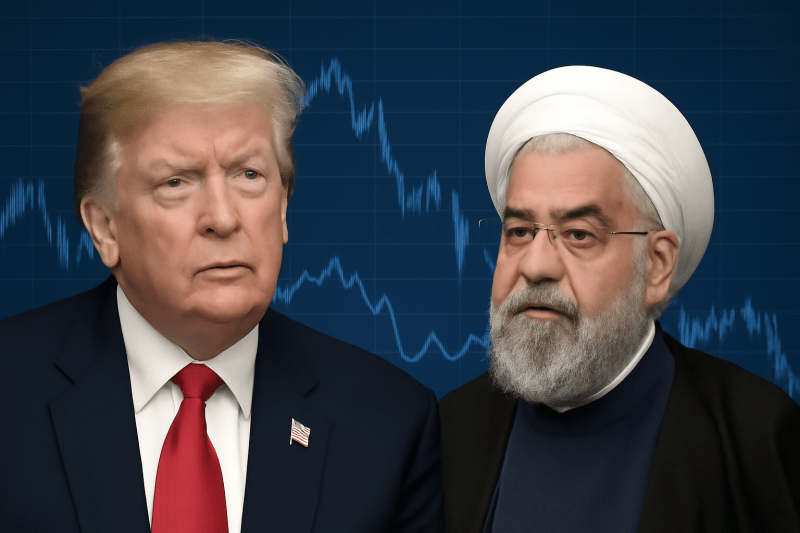
Market Analysis: Trump Seeks Negotiation, Iran Does Too!!!
As the fierce waves momentarily subside and calm ripples flow, the U.S. stock market is finding a delicate equilibrium. President Trump's negotiation cards are acting as a crucial variable determining the market's direction, prompting investors to take a breather.
Key Takeaways
1. The Art of Negotiation, The Market's Dilemma
Much like a seasoned negotiator delaying to exploit an opponent's weakness, President Donald Trump's actions create a palpable tension. Ahead of the deadline for the Iran nuclear deal, his rhetoric oscillates between hawkish and conciliatory, defying the predictions of market participants. The prevailing analysis suggests that President Trump fundamentally desires 'negotiation' itself. His objective extends beyond merely avoiding military conflict; it aims to secure the "free flow of oil transport," the carrot at the heart of the Iran nuclear deal. This situation is akin to the classic 'prisoner's dilemma,' where each party seeks to maximize their own interests, but mutual distrust can lead to a cycle of suboptimal outcomes. President Trump is seen as leveraging this dilemma to extract greater concessions from Iran. The market is exhibiting mixed signals amidst this uncertainty; while the Dow Jones, Nasdaq, and S&P 500 indices closed higher, this could be a temporary technical rebound. Breaking through the 20-day moving average is a positive sign, but the formidable resistance from the 50-day and 200-day moving averages remains a point of caution. The market is keenly awaiting tomorrow's pivotal developments, with eyes fixed on Iran's nuclear deal decisions and President Trump's subsequent actions.
2. Semiconductors: The Market's New Engine
Just as companies don't solely consider current returns when making new investment decisions, the current U.S. stock market is being driven by expectations for a specific sector: semiconductors. The rise of companies like Micron Technology, Sandisk, and Western Digital supports a positive outlook for the memory semiconductor segment ahead of Samsung Electronics' earnings report. This suggests that the driving force behind market movements is technological innovation, akin to magma breaking through the Earth's surface. The concurrent rise of semiconductor equipment companies further strengthens this trend. The market analysis indicates that semiconductors, particularly in the memory segment, are currently leading the market. This differs from the dot-com bubble era; it's a growth based on genuine technological advancements and increased demand, not just speculative excess. However, amidst this positive momentum, software and infrastructure-related sectors have not yet seen significant gains. Tesla, for instance, has seen limited upward momentum despite merger and acquisition news, as it hasn't directly translated into substantial earnings improvements. This mirrors the principle that a single tree cannot grow excessively in a forest. The broader technology sector is showing mixed performance, with semiconductors still playing the 'lead role' in driving the market. This dynamic is further reinforced by positive trends in the financial and industrial sectors. Out of the 11 sectors, including defense, financials, communication services (Google, Meta), industrials, consumer discretionary, energy, and technology, more than 8 are showing gains, indicating a warming trend across the market. This suggests that investors, while maintaining a cautious "wait-and-see" approach, are seeking investment opportunities based on expectations for specific sectors.
3. Warning Lights and Sparks of Hope in Economic Indicators
Economic indicators, much like complex puzzle pieces, sometimes reveal a clear picture and at other times leave ambiguous clues. The S&P 500 index has shown a positive signal by surpassing the 6,500 mark and breaking the 20-day moving average, but it faces potential deceleration due to psychological resistance at the 50-day and 200-day moving averages. This is akin to a hiker pausing to catch their breath while ascending a steep mountain. Whether it breaks through the 6,800 level will be a critical factor in determining future price movements. However, a sharp decline below the 6,300 level is considered unlikely, with a rebound expected around the 6,150 mark even if it falls. This signifies a solid underlying support, like a building constructed on a strong foundation. The Dow Jones and Nasdaq indices have also surpassed their 20-day moving averages but are similarly facing upper resistance. Tomorrow's market, in particular, could experience significant volatility due to a combination of these technical indicators and geopolitical uncertainties. The Russell index showing the strongest trend and breaking its 20-day moving average can be interpreted as a positive sign. International oil prices for both Brent and WTI are in a lull, awaiting the outcome of important events tomorrow. The 10-year Treasury yield is around 4.3%; as long as it doesn't exceed 4.5%, it's unlikely to place significant pressure on the market. The volatility index, VIX, recorded 24.1, suggesting that a break above 25 could heighten anxiety. The dollar index is also attempting to stabilize around the 100 mark; a strong break above this level could introduce further market volatility. Gold prices fell by 0.44%, indicating a slight weakening of risk appetite. The ISM Manufacturing PMI recorded a slight decrease from forecasts at 54.8, but it remains above the 50 mark, indicating economic expansion. However, persistent upward price pressure amplifies inflation concerns. This is like a river that appears calm on the surface but has strong currents underneath. These complex indicators suggest the market is at a critical crossroads, demanding a cautious approach from investors.
4. Hope Amidst Confusion: A Reinterpretation of the Strait of Hormuz
Analysis firms like Stirling Research suggest that tensions surrounding the Strait of Hormuz are not as severe as anticipated. They argue that actual tanker traffic reaches 15 million barrels per day, and oil transport is not entirely blocked as we might imagine. This is like a ship continuing its voyage resolutely despite forecasts of a storm. While the turmoil may not completely cease, there's a high probability of a "permanent risk premium." However, the prospect of recovery to 50% of pre-conflict levels within the next 4-6 weeks offers a hopeful message. This is akin to the belief that a deep wound will gradually heal over time, provided it doesn't become infected. The U.S. stock market's upward trend following President Trump's remarks on a ceasefire is not unrelated to this analysis. President Trump has clearly stated "free flow of oil transport" as a key demand in negotiations with Iran, aiming to secure stable passage through the Strait of Hormuz. This is like identifying and focusing on the most crucial knot to untangle a complex mess. These diplomatic efforts and subtle shifts in geopolitical situations are having a positive impact on the market. Although Iran rejected President Trump's ceasefire proposal, its openness to negotiations with the U.S. fosters hope that the situation will not escalate to a complete breakdown. Despite past incidents that heightened tensions, such as attacks on Israeli oil facilities and the killing of an Iranian Revolutionary Guard commander, there are also observed efforts to manage the situation, like the passage of a Turkish-owned vessel through the Strait of Hormuz and operations by the U.S. Central Command. These multifaceted factors encourage market participants to harbor a "cautious optimism" rather than complete pessimism. Will this period of confusion pass, and will the market find a new equilibrium and regain stability? Or will it be swept away by the relentless waves of geopolitical risk? These are questions we all must deeply ponder.
This post is based on content from the YouTube channel 올랜도 더 미국주식.
Watch the original video: https://youtu.be/m8bHhVQCMlw
Note: This content is a column written with AI analysis based on the referenced video. For accurate context and the creators intent, we recommend watching the video via the link above.

