Trump Fatigue? Is the Market Seeking an Exit Strategy as the Next Week Becomes a Crucial Turning Point?
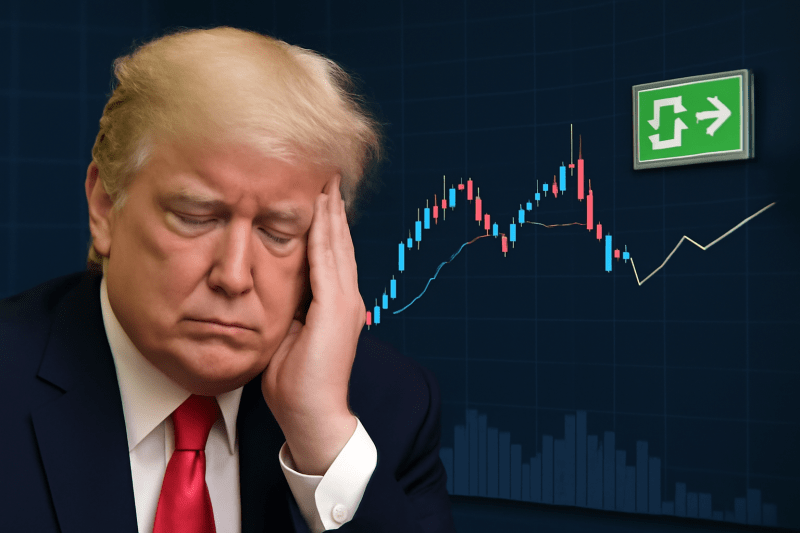
The wheels of history sometimes turn in unexpected directions, defying our predictions. Like a small boat in turbulent waters, the financial market is constantly shaken by unpredictable external factors. A thick fog of uncertainty now hangs before us, and it has become more important than ever to find a clear direction to navigate through this fog.
Key Takeaways
1. The Calm Before the Storm: The Shadow of Uncertainty Gripping Sentiments
Much like the stillness before a storm, the current financial market is in a state of extreme tension due to unpredictable variables. In particular, the political uncertainty surrounding former President Donald Trump is a key factor causing persistent anxiety in the market. Each of his statements creates diplomatic and economic ripples, playing with the sentiments of market participants. In the past, during the Trump administration, the tug-of-war between threats of tariffs and their actual implementation caused significant market volatility, leaving investors fatigued by this unpredictability. This situation has manifested as individual investors' net selling of stocks since November 2023, and unlike in the past, they are not actively buying during stock price declines. According to JPMorgan's analysis, recent inflows from individual investors are only half the average of the past 12 months, acting as a factor that dampens market vitality. The outflow of individual investor funds, like the receding tide, reduces market liquidity and weakens the momentum for stock price increases. This phenomenon reflects individual investors' anxiety about short-term market trends and raises questions about the effectiveness of the past "buy-the-dip" strategy. The escalating geopolitical tensions in the Middle East and the resulting oil price surge are amplifying inflation concerns, which in turn increase the possibility of central bank interest rate hikes, further fueling market anxiety. Ultimately, the uncertainty surrounding Trump and geopolitical risks are intertwined, amplifying market unpredictability and creating a pre-storm situation that dampens investor sentiment. In this context, investors need to read market changes through more objective and multi-layered analysis, rather than relying solely on past experiences or intuition.
2. The Inflation Trap and the Interest Rate Dilemma
The sustained rise in oil prices is, like an invisible hand, intensifying inflationary pressures across the entire economy. This leads to rising consumer prices, weakening household purchasing power, and increasing corporate production costs, creating a vicious cycle. In the past, production cuts by Saudi Arabia or escalating geopolitical tensions in the Middle East have always been triggers for international oil price hikes, effectively setting an inflation trap for the global economy. These inflationary pressures push central banks into a monetary policy dilemma. Even if the economy shows signs of slowing down, central banks, prioritizing price stability, are more likely to attempt to curb inflation through interest rate hikes or holds rather than cuts. In fact, the U.S. Federal Reserve (Fed) has been delaying interest rate cuts despite recent economic indicators suggesting a robust labor market, which is exerting upward pressure on market interest rates. Specifically, the situation where the 10-year Treasury yield exceeds 4.3% and the 30-year yield approaches 4.9% amplifies concerns about an economic recession. Historically, the inversion of long-term and short-term interest rates has been considered a leading indicator of economic recession, and the current high interest rate levels can dampen corporate investment and household consumption, potentially putting the brakes on economic growth. Rising interest rates directly impact technology stocks, especially the Nasdaq market. Technology companies often rely on debt financing during their growth phases, and high interest rates increase their interest burden, worsening profitability. Furthermore, as the discount rate for the present value of future cash flows increases, the intrinsic value of tech stocks declines. Companies related to semiconductors, semiconductor equipment, and storage devices are bearing the brunt of these rising interest rates, leading to stock price declines in these sectors. Ultimately, inflation imposes the shackles of interest rates, restricting economic growth, which in turn negatively affects the stock market, particularly the growth-stock-centric Nasdaq market, creating a complex dilemma.
3. The Market's Turning Point: Hidden Opportunities Next Week
We are standing at a significant turning point in the financial market. Just as a navigator might drop anchor during a storm to assess the situation, market participants anticipate that the direction of the market will be determined from next week onwards. Looking at past examples, the release of important economic indicators, central bank monetary policy decisions, or geopolitical events have all served as triggers for trend reversals in the market. For instance, the sharp stock price fluctuations before the Great Depression in 1929 or the financial market turmoil during the 2008 global financial crisis were all cases where unexpected events combined to drastically change market trends. Currently, the market is exhibiting high volatility due to a complex interplay of negative factors: Trump's political remarks, oil price instability originating from the Middle East, and the consequent inflationary and interest rate pressures. Amidst this uncertainty, the economic indicators and major political decisions to be announced next week will be crucial benchmarks for gauging the market's direction. If positive economic data emerges along with signs of easing geopolitical tensions, the market may breathe a sigh of relief and seek opportunities for a rebound. Conversely, if the situation worsens, a further deepening of the current downtrend cannot be ruled out. In particular, if major market support levels are breached, the S&P 500 index could potentially fall further to the 6,150 level. However, opportunities exist even within this downtrend. According to the psychological "loss aversion bias," people tend to prioritize avoiding losses over gaining profits. Therefore, if the market falls excessively, there may be movements from investors looking to capitalize on it as a buy-the-dip opportunity. Furthermore, due to the "anchoring effect," the memory of past high prices might make current low prices seem expensive, but if the intrinsic value of companies is analyzed objectively, it could present an opportunity to discover undervalued blue-chip stocks. Ultimately, next week will be a crucial juncture for market participants to overcome uncertainty and set a new direction, and wise investors will be able to seize opportunities with a long-term perspective during this period.
4. Investment Navigation in an Era of Uncertainty: Following the Compass and Stars
Modern society lives in a flood of information. Like a maze in a complex city, the financial market is entangled with countless pieces of information and variables, making it easy to get lost. To continue successful investing in this era of uncertainty, we need clear principles and strategies that will guide us in the right direction, like a compass and stars, rather than simply reacting to short-term market fluctuations. First, the principle of "diversification" must be firmly established. This is the most basic strategy to protect a portfolio from unexpected market shocks by diversifying risk, akin to the adage, "Don't put all your eggs in one basket." By diversifying investments across various asset classes, industries, and regions, the risk of a sharp decline in any single asset can be mitigated. Second, a "long-term perspective" must be maintained. While short-term market volatility is inevitable, historically, the stock prices of blue-chip companies have tended to rise over the long term. Successful investors like Warren Buffett pursue long-term growth by investing in the intrinsic value of companies, without being swayed by short-term market noise. The "magic of compounding" has the powerful effect of exponentially increasing investment returns over time, making it important to execute long-term investments with patience. Third, the philosophy of "value investing" must be internalized. This is not simply about buying cheap stocks, but rather a strategy of analyzing a company's intrinsic value and investing in high-quality companies that are undervalued compared to their current market price. As presented in Graham's "The Intelligent Investor," securing a margin of safety and excluding emotional decisions are key. Fourth, one must possess "continuous learning and flexibility." The economic environment and market conditions are constantly changing. Therefore, the ability to acquire new information, continuously review one's investment strategy, and adjust it flexibly when necessary is important. Just as Shakespeare's Hamlet agonized over the fundamental question of "to be or not to be," it is important for investors to establish their investment philosophy and adhere to unwavering principles amidst the constantly changing market environment. Finally, "psychological control" is one of the most important factors for successful investing. Basic human emotions of greed and fear can cloud investment decisions. Therefore, training is needed to recognize and control one's emotions and make rational decisions based on objective data. With these principles as our compass, and sometimes checking our direction by the stars, we can navigate the sea of uncertainty and reach our destination.
This post is based on content from the YouTube channel 올랜도 더 미국주식.
Watch the original video: https://youtu.be/VHjoP53GI0A
Note: This content is a column written with AI analysis based on the referenced video. For accurate context and the creators intent, we recommend watching the video via the link above.

