Tesla's True Value: Beyond the Hype of Robotaxis and Optimus, Why the Semi Truck Matters
The Enigma of Tesla's Valuation: Unpacking the Real Drivers
Like a lighthouse illuminating the path through darkness, Tesla presents a grand vision of future mobility that captivates us. But what are the tangible forces behind its current value, hidden beneath that dazzling blueprint?
Key Takeaways
1. Justifying a Colossal Valuation: What's the Real Story?
Like a mythical giant, Tesla boasts a market capitalization that dwarfs traditional automakers. Despite lower production volumes and profit margins than Toyota, it commands a premium of over five times. This reality begs the question: can intangible assets like software innovation and ecosystem building truly bridge this immense gap? The paradigm shift towards a deep tech platform is shaking the very foundations of automotive manufacturing, revealing an ambition to build an ecosystem far beyond mere transportation. However, declining gross margins and reduced delivery numbers cast a shadow on this optimistic outlook. Investors are attempting to offset current financial burdens with expectations for future technologies like autonomous driving, the humanoid robot 'Optimus,' and the next-generation transport system 'Quix.' Yet, it remains uncertain how effectively these investments will preserve and grow future cash flows. This is a critical juncture demanding constant scrutiny to determine if Tesla's intrinsic value can support its current lofty valuation. It's akin to the baobab trees in Antoine de Saint-Exupéry's 'The Little Prince,' which, if not removed in their infancy, can engulf everything.
2. The Semi Truck: Tesla's Hidden Engine for Valuation
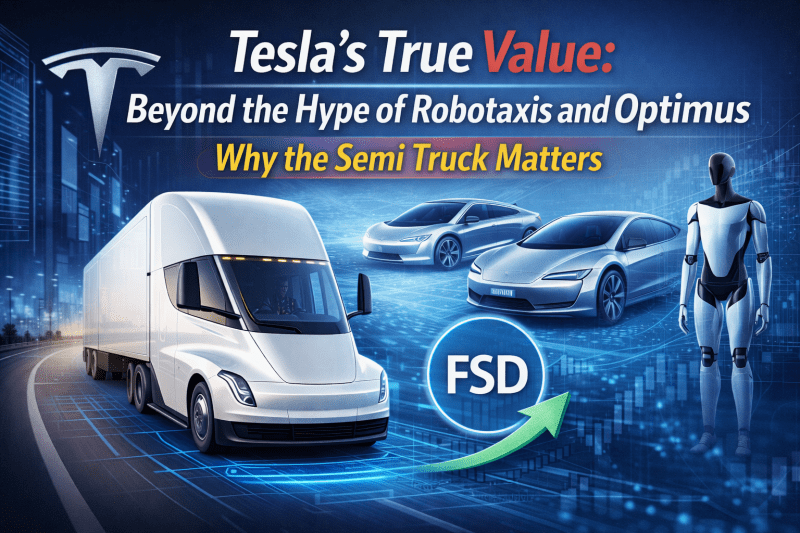
The two primary drivers explaining Tesla's current high valuation are software margins and hardware innovation, with the Semi truck being particularly noteworthy. Full Self-Driving (FSD) software, with over 1.1 million subscribers and more than 10 billion miles of driving data accumulated, represents a significant pipeline component, boasting a high net margin exceeding 80%. However, the true potential appears to lie in hardware innovation, specifically the Semi truck. The strategy to enter the global logistics market through mass production of 4680 batteries' dry electrode technology and Total Cost of Ownership (TCO) innovation provides a foundation to further solidify Tesla's valuation. The plan to prove intrinsic value through a sum-of-the-parts valuation model by 2027 becomes even more robust when including the energy storage business. The key to the Semi truck lies in battery cost reduction, with the 4680 battery's dry electrode technology serving as the catalyst. Unlike conventional wet batteries, it drastically shortens drying time, enhances energy efficiency, reduces factory footprint, and is advantageous for environmental compliance. A cost saving of 3-50% per kW translates to a price competitiveness of at least $30,000 per truck, leading to approximately $22,500 in net fuel cost savings over five years compared to diesel trucks. Furthermore, its proprietary 1.2 MW charging infrastructure enables 70% rapid charging, offering an overwhelming 25% cost advantage over diesel in terms of total ownership cost. This suggests that the Tesla Semi can gain a favorable position against the incumbent diesel trucks, much like David against Goliath. By 2030, it is projected to capture 15-20% of the European electric truck market, providing Tesla with a powerful economic moat. This demonstrates an ambition to reshape the market through new technological standards, much like Napoleon conquering the European continent after the French Revolution.
3. Ambitions for the Future: The Gap with Reality
Tesla is highly regarded as a future technology platform, but its short-term financial performance will be heavily influenced by the growth of Full Self-Driving subscriptions and its energy storage business. While these two ventures are recurring, high-margin revenue streams, the current valuation is based on the premise of successful, innovative future technologies, introducing an element of uncertainty. The capital expenditure plan exceeding $20 billion in 2020 is earmarked for ambitious projects in AI and robotics, which could pressure free cash flow in the short term. Consequently, some analyses suggest the risk-reward ratio is currently unfavorable, leading some investors to issue sell recommendations. They emphasize the need to focus on the growth of Full Self-Driving and the energy storage business to support the valuation. Tesla continuously excites investors with new narratives and grand promises, but the market harbors expectations that robotaxis, autonomous driving, and robotics will eventually drive tangible results. However, these futures are unpredictable and likely to take many years. Therefore, analyzing the factors that will actually drive Tesla's financial performance over the next 3-5 years would be a more realistic approach. This hints at a moment requiring deliberation over action, much like Shakespeare's 'Hamlet.'
4. Realistic Value Creation Drivers: Software and Energy
Tesla's most realistic growth drivers are Full Self-Driving subscriptions and the energy storage business. With over 1.1 million paid subscribers by the end of 2025, it signals the beginning of a subscription business built on Tesla's vast vehicle fleet. The transition to a $99 monthly subscription model and the potential for revenue generation through ride-sharing quietly demonstrate the establishment of a recurring revenue structure for software within the hardware business. If the subscriber base expands to 5 million, it is estimated to generate $6 billion in annual recurring revenue and $3-4 billion in operating profit, serving as a crucial benchmark for Tesla's short-term value. The greatest strength of Full Self-Driving lies in its unreplicable data moat. Nearly 10 billion miles of real-world driving data are core to FSD performance improvement, and subscriber growth further accelerates data accumulation in a virtuous cycle. The energy storage business also targets 4.6 GW of installations by 2025, showing a gross profit margin close to 30% and an upward trend. The acquisition of a grid permit by its UK subsidiary suggests the possibility of a shift towards recurring revenue structure as a utility business in the long term. Nevertheless, the issue remains with the valuation. The prevailing analysis suggests that the growth of FSD subscriptions and the energy storage business, without radical innovation, will struggle to sustain the excessively inflated valuation. The current free cash flow of $1.4 billion and cash reserves of $44 billion provide a solid foundation for the future, but investors should focus on the drivers of tangible value creation rather than the dazzling demonstrations of future technologies. Just as Renaissance artists, while depicting Christian utopias, infused their works with human anguish and reality, Tesla must find a balance between its future vision and realistic profit generation. Ultimately, Tesla's future may depend as much on, if not more than, its technological innovation, on its ability to orchestrate realistic business models and market expectations.
This post is based on content from the YouTube channel 올랜도 킴 미국주식.
Watch the original video: https://youtu.be/F_OGVcs0-rs?si=kFQYID56gabYgqAq
Note: This content is a column written with AI analysis based on the referenced video. For accurate context and the creators intent, we recommend watching the video via the link above.

