Oil Surge vs. Stock Resilience: Navigating Market Uncertainty and Trump's Influence
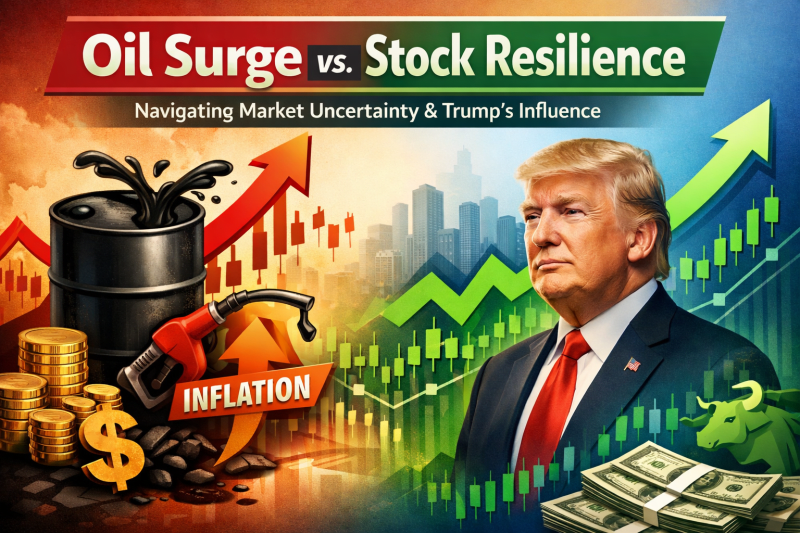
Amidst an economy shadowed by inflation, a colossal wave of oil prices is rocking the stock market. Despite fiercely soaring oil prices, stocks are exhibiting unexpected tenacity, a result of complex psychology at play beyond mere market volatility.
Key Takeaways
1. Amidst the Fog of Uncertainty, a Paradox in Investor Psychology
Much like a foggy London morning, the current financial market is shrouded in various uncertainties. The rise in oil prices due to escalating geopolitical tensions raises concerns that it could dampen consumer sentiment and increase corporate production costs, potentially stalling overall economic activity. Indeed, heightened tensions involving Iran have pushed oil prices above $100, directly impacting energy-intensive industries. Weak employment figures also fuel market mixed signals by stimulating expectations for interest rate cuts. However, despite these negative signals, stocks are showing unexpected resilience, suggesting investor reluctance to divest large assets and the presence of potential buyers looking for a bargain. Like a mighty tree standing firm in a storm, the market appears to have developed a certain level of resistance to external shocks. This phenomenon can be interpreted as a complex interplay of two opposing tendencies in human psychology during crises: risk aversion and opportunity seeking. Market participants are simultaneously exhibiting an instinct to avoid immediate losses and strategic thinking to capitalize on potential gains from price drops. This demonstrates that investor sentiment doesn't just react to economic indicators but is evolving through adaptation and learning in the face of uncertainty.
2. Hidden Opportunities Amidst Mixed Signals: A Re-evaluation of Bargain Hunting Strategies
The current market is akin to a ship navigating through dense fog. While some stocks, particularly in the tech sector, have shown upward momentum, the overall market is characterized by individual stock performance, making it difficult to discern a clear direction. Although some companies like Micron Technology are seeing their stock prices driven by earnings expectations, large-cap stocks like Tesla have only managed a slight increase, bolstered by the growth momentum in the semiconductor industry. Meta, after a significant rise, has plateaued, while defensive sectors such as healthcare, consumer goods, industrials, telecommunications, and utilities have seen declines. This market mixed signals are sending a clear message to investors: it's a time that requires a cautious approach rather than blind investing. However, opportunities for bargain hunting clearly exist within this environment. The fact that the fear and greed index indicates extreme fear at 22 is a signal that suggests considering phased buying, especially for quality stocks. Like shells revealed on a beach after the tide recedes, a strategy of gradually accumulating good stocks as the market dips can be effective in the long term. This strategy cleverly utilizes the 'loss aversion' tendency and 'availability heuristic' from behavioral economics. Instead of hesitating to buy due to the fear of immediate losses, it's important to execute a rational phased buying plan by recalling past market recoveries during crises. This is like climbing a difficult mountain; instead of rushing to the summit, you pause at intermediate points to catch your breath, conserve energy, and advance slowly.
3. Trump-Induced Uncertainty: Shaking the Market's Pendulum
Another factor amplifying current market uncertainty is the presence of President Trump. Every word he utters sways the market's pendulum, adding to unpredictability. His actions are drawing particular attention, especially in conjunction with the geopolitical tensions in the Middle East. Like an actor on a stage, Trump's statements have a profound impact on international relations and the economy, which in turn leads to market volatility. The perspective that sees April 15th as a deadline further amplifies this Trump-induced uncertainty. Depending on whether the war ends or a new conflict begins, the market could face drastic changes. This situation is like a tightly drawn bowstring; market participants are on high alert, with the tension of an arrow being loosed at any moment. Furthermore, analyses from investment banks like Goldman Sachs highlight this uncertainty. Their assertion that the market is underestimating the risk of war with Iran serves as a warning to investors. This is akin to a warning that even a seemingly calm sea might hide a massive storm in its depths. President Trump's unpredictable remarks and actions further exacerbate this uncertainty, urging market participants to prioritize thorough risk management over premature optimism. This is like a captain navigating treacherous waters meticulously preparing for inclement weather.
4. Insight Beyond Data: Balancing Observation and Phased Buying
Technically speaking, the current market is not in a clear upward trend. Major indices like the Nasdaq, S&P 500, and Russell are undergoing period and time adjustments, and it is expected that a certain amount of time will be needed to transition into an upward trend. While the S&P 500 index remaining above its 200-day moving average is positive, some analyses suggest that a true upward trend cannot be expected without a recovery in financial stocks. Although the decline in the 10-year Treasury yield and the stabilization of the VIX index are acting as drivers for stock rebounds, this could be a temporary phenomenon. For Bitcoin, the key will be whether it can break through $74,000, and a weaker dollar could also have a positive impact on stock prices. However, it is difficult to definitively predict the market's future based solely on these technical and macroeconomic indicators. What is important is the human psychology and judgment used to interpret these data. The fact that the market, which was overwhelmingly optimistic just six weeks ago, has suddenly shifted to a skeptical view is a prime example of how quickly human sentiment can change. Like leaves falling in the autumn wind, market sentiment can change in an instant. Therefore, at this juncture, it is wise to maintain a cautious observational stance and explore market direction rather than actively buying. However, a phased buying strategy focused on quality stocks can be an effective means of strengthening a portfolio from a long-term perspective. This is like the wisdom of pausing to survey your surroundings and sometimes stepping back to choose a safer path when facing a difficult journey, rather than blindly pushing forward. Ultimately, navigating this era of uncertainty requires finding a balance between observation and action, based on insight beyond data and a deep understanding of human psychology. This balanced approach will serve as a compass, protecting investors and capturing opportunities amidst unpredictable market conditions.
This post is based on content from the YouTube channel 올랜도 킴 미국주식.
Watch the original video: https://youtu.be/p2Iy9Mx_-ws?si=2wzbkJtZmgeH6Tk4
Note: This content is a column written with AI analysis based on the referenced video. For accurate context and the creators intent, we recommend watching the video via the link above.

