Navigating Market Turmoil: VIX, Backwardation, and Finding the Bottom
Navigating Market Turmoil: VIX, Backwardation, and Finding the Bottom
Like a ship navigating a turbulent sea, the financial markets are often engulfed by unpredictable waves. Sometimes, it's a massive whirlpool hidden beneath a calm surface, and at other times, it's a fierce storm that throws investors into confusion. Amidst this uncertainty, what should be our guiding principles, and how should we move forward?
Key Takeaways
1. The VIX Index: Gauging the Market's Temperature
Within the complex dynamics of financial markets, several key indicators measure investor sentiment. Among these, the CBOE Volatility Index, or VIX Index, often called the 'fear index,' is akin to the market's temperature. The recent surge of the VIX Index to the 35 level before falling to 26 still signals significant future market volatility. It's a sign that the market has not yet found stability, much like a patient recovering from a fever. Heightened geopolitical tensions in the Middle East intensified selling pressure, leading to a 3% drop in the S&P 500 Index and a surge in oil prices. The nearly 40% spike in Brent crude and WTI crude futures, pushing Brent crude prices close to $100 per barrel, further amplified investor anxiety. Historically, when the VIX Index surpasses 35, it has often signaled a potential short-term market peak. During periods of extreme volatility, such as the COVID-19 pandemic in 2020 or the Silicon Valley Bank (SVB) collapse, the VIX Index exceeded 40, and at these levels, the market tended to bottom out and turn upwards. Therefore, the current movement above 35 can be interpreted as a process towards a short-term peak. However, it also suggests that if we enter a phase of extreme fear with the VIX Index exceeding 40, it could present a buying opportunity. This is akin to dropping anchor and waiting out a storm, or preparing for a new voyage after the storm has passed. Investors must closely monitor these movements of the VIX Index to read the market's psychological shifts. Nevertheless, the fact that the S&P 500 Index has only fallen about 4% from its all-time high suggests that the current correction has not yet evolved into a full-blown downtrend, indicating that market participants are not yet gripped by extreme fear. Investors need to consider these indicators comprehensively and approach the market cautiously rather than making hasty judgments.
2. The Oil Market Paradox: Backwardation and the Supply Chain Dilemma
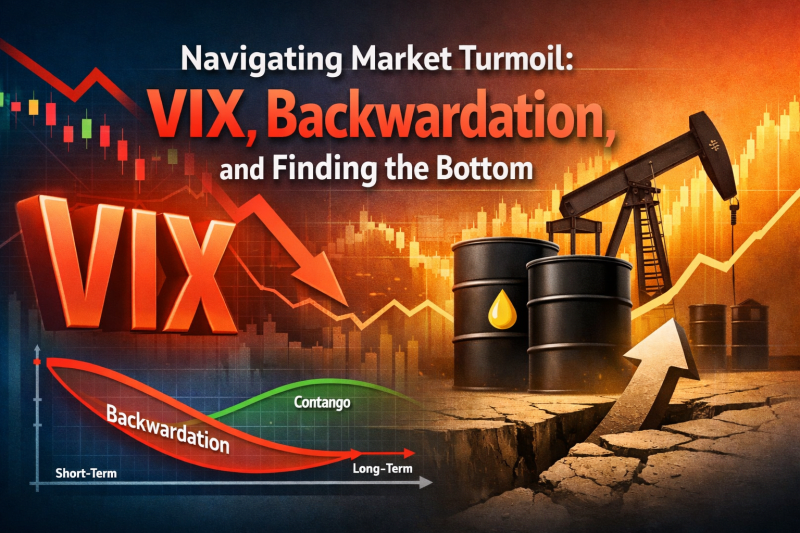
The phenomenon of 'backwardation' in the oil futures market provides crucial clues to understanding the current market situation. Backwardation occurs when futures prices are lower than spot prices, indicating severe short-term supply shortages but not necessarily long-term ones. It's similar to how a temporary water shortage might intensify immediately after a flood, only to return to normal levels soon after. The fact that near-month futures prices for major oil benchmarks like Brent crude and WTI are higher than their longer-dated counterparts is evidence of this backwardation. This indicates that concerns over supply disruptions due to heightened geopolitical tensions in the Strait of Hormuz are causing short-term supply-demand imbalances. While the Trump administration has implemented various measures to curb rising oil prices, such as releasing strategic petroleum reserves and exempting from the Jones Act, these are largely seen as temporary fixes, like applying a bandage to a wound. The fundamental solution lies in ensuring safe passage through the Strait of Hormuz and normalizing the supply chain. If oil production in the Strait of Hormuz were to halt, there are virtually no alternative supply sources. Investment banks like Goldman Sachs are raising their oil price forecasts, citing the possibility of supply disruptions lasting longer than expected. Extreme scenarios even predict further price increases for Brent crude. Market participants anticipate that these short-term supply pressures will not lead to a long-term oil price uptrend, and the widening of the spread (the difference between near-month and far-month prices) reflects this belief. President Trump's expressed willingness to resolve this issue quickly through negotiations partially reflects market expectations, which is manifesting as backwardation in the futures market. However, it is clear that the longer the Strait remains closed, the longer it will take for oil prices to stabilize. The oil market is thus exhibiting high volatility due to a complex interplay of geopolitical risks and short-term supply-demand factors. Investors need to meticulously analyze these intricate factors and possess the wisdom to grasp the market's long-term trends rather than reacting impulsively to short-term fluctuations.
3. The Compass of Investor Psychology: The Greed-Fear Index and Opportunities for Bargain Hunting
Investor sentiment in financial markets constantly fluctuates like massive waves, profoundly impacting market direction. One tool that measures the extremes of this sentiment is the 'Greed-Fear Index.' The recent drop to the 'extreme fear' zone at 21 is noteworthy. This signifies that market participants are gripped by excessive anxiety, and historically, such levels have served as a catalyst for market bottoms and subsequent rebounds. It's like how people become fearful during a storm, but calm follows its end. Investors should leverage these 'extreme fear' phases as opportunities for bargain hunting. It's particularly important to focus on profitable companies with sound financials and high growth potential, rather than those with negative earnings per share (EPS>). These companies are more likely to maintain relative stability during market downturns or show a swift recovery after a sharp decline. For companies with losses, it's wiser to approach them after the market shows signs of recovery. Buying companies with losses during a market downturn can be akin to jumping onto a sinking ship. Instead, buying growth stocks of profitable companies is like choosing a sturdy vessel for a stable voyage. The Put-Call Ratio is another crucial indicator for understanding investor sentiment. Put options are instruments that bet on price declines, so a high Put-Call Ratio indicates that market participants have significant concerns about a downturn. Historically, when the Put-Call Ratio rose to around 70, the S&P 500 Index tended to bottom out and rebound. This suggests that when investors widely purchase put options, assuming the worst-case scenario, the market is more likely to form its bottom. The current gradual rise in the Put-Call Ratio indicates growing anxiety among market participants, and if it enters an extreme fear phase, with the VIX Index rising to 40, it could act as a strong buy signal. Thus, market bottoms often coincide with investors' greatest fears. Fear can cloud rational judgment, but it also conceals great investment opportunities.
4. Questions for the Future: Charting a Course Amidst Uncertainty
Human history has been a continuous series of uncertainties and challenges. We learn from past experiences, analyze current situations, and strive to predict the future. Financial markets can be seen as a microcosm of this human experience. The rising VIX Index, soaring oil prices, and the phenomenon of backwardation are all sending clear messages about the current market. The market remains unstable, and geopolitical risks and supply chain issues are challenges that will not be easily resolved in the short term. However, amidst this uncertainty, investors must maintain a cool head and leverage 'extreme fear' phases as opportunities, approaching investments with a long-term perspective. Selective investment in profitable companies, especially high-quality ones with strong growth potential, can be a strategy that shines during crises. Furthermore, efforts to identify market bottoms using investor sentiment indicators like the Put-Call Ratio should be undertaken concurrently. Just as calm seas follow a rough voyage, new growth and opportunities may lie beyond the current instability. Yet, we face a question: If history repeats itself, how powerful a compass will the lessons learned from past crises be in navigating the uncertainties of the present and future? And amidst these waves of uncertainty, what must we prepare to capture true value and achieve sustainable growth?
This post is based on content from the YouTube channel 올랜도 킴 미국주식.
Watch the original video: https://youtu.be/eLorrWtSiIE?si=XTTEiy5yj_-QLtDD
Note: This content is a column written with AI analysis based on the referenced video. For accurate context and the creators intent, we recommend watching the video via the link above.

