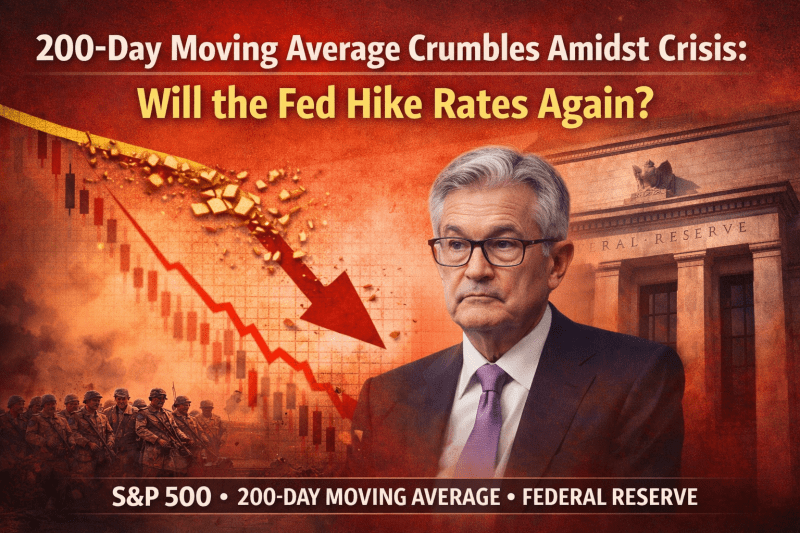
200-Day Moving Average Crumbles Amidst Crisis: Will the Fed Hike Rates Again?
Key Takeaways
1. The Shadow of War Triggers Market Instability
Just as stars shine brightest in the deepest darkness, the current global financial markets are facing a trial so severe that even starlight seems to fade. The S&P 500 index's fall below the 200-day moving average, a drop of 1.7%, serves as more than just a technical breach; it's a powerful signal that's shaking the very psychology of market participants. The 200-day moving average has long been a crucial benchmark for gauging the long-term trend of an asset. Its collapse signifies a fundamental weakening of market momentum. Much like a dam develops hairline cracks before it breaks, this indicator's deviation acts as a compass warning of latent risks. The pattern of showing signs of recovery only to fall back down again amplifies the deep-seated anxiety and uncertainty within the market. Such situations, as seen in past financial crises, can lead to prolonged bear markets rather than mere temporary corrections. Human psychology is inherently sensitive to risk, and the 'loss aversion' bias reacts more strongly to negative signals than positive ones. Consequently, the breach of the 200-day moving average can amplify investors' fears of further declines, creating a vicious cycle that fuels more selling pressure. It's a moment where investors, feeling like they're on the edge of a cliff, must focus on rigorous risk management rather than premature optimism. The fact that even individual investors are adopting an unprecedentedly conservative stance starkly illustrates the heightened tension in the current market. This reflects not just market sentiment but the undeniable reality of objective data and indicators flashing warning signs.
2. The Inflation Catastrophe: The Return of the Rate Hike Card
Beneath the looming cloud of war, another monster, inflation, is rearing its head. Soaring oil prices are not just about energy costs; they drive up production expenses, leading to widespread price increases that dampen consumer sentiment and erode corporate profitability. In this environment, the market's most sensitive reaction is to central bank monetary policy. The Federal Reserve's previous stance of stimulating the economy through rate cuts now faces the possibility of a complete reversal. The 2-year Treasury yield surging to 4% has heightened market concerns about whether an 'emergency rate hike' might be necessary before the April Federal Open Market Committee (FOMC) meeting. The market sentiment, which just a month ago predicted rate cuts within the year, has drastically shifted, with bets on a rate hike now reaching 12%. This vividly demonstrates the market's anxiety that geopolitical risks are not merely diplomatic friction but are imposing severe inflationary pressures across the real economy, potentially forcing the Fed to wield the powerful tool of monetary tightening once again. Just as a doctor might choose a painful treatment to save a patient's life, the Fed may consider the unavoidable choice of raising interest rates to rescue the economy from the fatal disease of inflation. Such a policy shift could increase corporate borrowing costs, further dampen investment and consumption, and exert additional downward pressure on the market. BlackRock's projection that oil prices could climb to $150 even after the war ends is based on the prediction that supply chain recovery will take considerable time. Furthermore, the fact that the Trump administration is reportedly considering scenarios where oil prices could reach $200 serves as a stark warning of how severe the current situation could become. This suggests a destructive impact on our daily lives and economic activities, much like an uncontrollable wildfire.
3. Opportunity Amidst Risk: Exploring the Potential of Contrarian Investing
Goldman Sachs' analysis suggesting that taking a 'short' position in the midst of this turmoil is itself risky hints at the need to identify paradoxical opportunities amidst market chaos. Of course, this analysis is based on the premise that the market is oversold and has "sold off enough," and it may reflect the sentiment of expecting a short-term rebound. However, true insight comes from calmly identifying valuable assets when everyone else is panicking and selling. Just as we can only see the clear sky after the storm has passed, there's a possibility that new order and opportunities lie hidden behind the current extreme volatility. Regarding advancements in deep learning chip technology, while Google's TPU (Tensor Processing Unit) is creating new waves in the semiconductor market, there's also an interpretation that it might act as a catalyst for technological advancement rather than a direct threat to the HBM (High Bandwidth Memory) market. Paradoxically, when the development of a certain technology is accompanied by price declines, it can lead to broader adoption and drive the growth of the entire market. Historical data shows that after the 200-day moving average has broken, it has mostly rebounded after a certain period, providing a reason not to abandon hope for the market in the long term. Of course, predicting when and with what intensity this rebound will occur is difficult. What's important is how we interpret the current crisis and what strategies we adopt. Instead of hastily selling everything in extreme fear, a wise approach might be to focus on the intrinsic value of the assets you invest in and look for opportunities for dollar-cost averaging with a long-term perspective. Furthermore, while negotiations with Iran appear to have officially broken down, the fact that communication through diplomatic channels is still ongoing leaves open the possibility that geopolitical risks could be de-escalated at any time. The confirmation of a US-China summit raises expectations for a relaxation of international tensions, which could have a positive impact on financial markets. Ultimately, a balanced perspective is needed, one that considers the worst-case scenario while simultaneously acknowledging the possibility of the best-case scenario materializing. So, how should we, living in this era of uncertainty, protect our assets with preparation and mindset amidst the coming wave of change?
This post is based on content from the YouTube channel 이효석아카데미.
Watch the original video: https://youtu.be/dt3zofTXYrY?si=t09LpIV6rrQcYeEu
Note: This content is a column written with AI analysis based on the referenced video. For accurate context and the creators intent, we recommend watching the video via the link above.

